
Some links below are affiliate links. If you buy through one, we earn a commission at no extra cost to you. It never changes a verdict — here is how that works.
How this guide was built: it compares manufacturer-published specifications and current listings. We have not bench-tested these products, and nothing below claims otherwise. Where a spec matters to the decision, we say which one and why.
Most travel-power mistakes come from buying the wrong kind of thing: a plug adapter when the problem was wattage, a huge power bank that an airline won’t allow, or a “universal” adapter for a trip that only ever needed a two-dollar Europe plug. Start with the three rules, then pick by trip.
Three rules before you buy anything
1. An adapter changes the plug shape, not the voltage
Every product on this page is an adapter, not a converter. It lets a US plug fit a foreign socket; it does not turn 230V into 120V. Phone, tablet, camera and laptop chargers are almost all marked “Input: 100–240V” and work anywhere with just an adapter. Single-voltage heat appliances — many US hair dryers, curling irons and clothes steamers — are not, and will burn out or trip a breaker on 230V. Read the fine print on the device’s own label before you pack it; if it says 120V only, leave it at home or buy a dual-voltage version.
2. Airlines cap power banks at 100 Wh, carry-on only
Under FAA and IATA rules, spare lithium batteries — which includes every power bank — go in carry-on bags only, never checked luggage. Up to 100 watt-hours needs no approval; 101–160 Wh needs the airline’s permission; above that is not allowed. The rating should be printed on the case. If only mAh is shown, multiply by the cell voltage (about 3.6–3.7V) and divide by 1,000: a 20,000mAh bank is roughly 72–74 Wh, and 27,000mAh is the practical ceiling. Several airlines, particularly in Asia, now also restrict using or charging a power bank during the flight, so check your carrier before you rely on one at the seat.
3. Laptops need real USB-C wattage
The USB ports built into travel adapters are mostly phone-speed. A thin laptop wants at least 45–65W from a single USB-C port; a larger one wants 100W. Look for the single-port maximum, not the headline total — a “5-port” adapter that shares 15–20W across its USB ports will charge a phone overnight and do almost nothing for a laptop. If your adapter’s USB ports are weak, that is fine: plug the laptop’s own charger into the adapter’s AC socket instead.
The picks at a glance
| Product | Type | Key manufacturer specs | Best for |
|---|---|---|---|
| TESSAN European Travel Plug Adapter | Single-region plug (Type C) | 1 US AC outlet + 2 USB-A (2.4A) | A Europe-only trip, phones and a laptop brick |
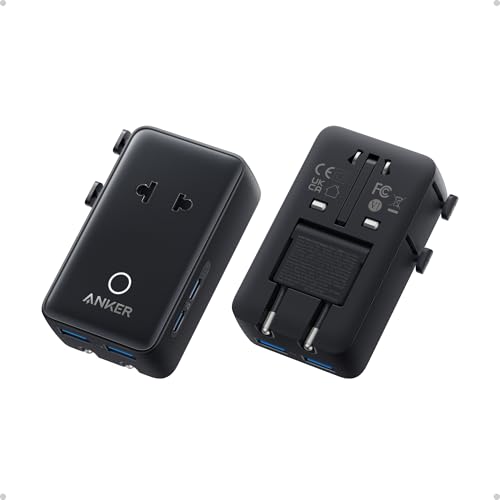
| Anker Nano Travel Adapter (5-in-1, 20W) | Universal adapter | 1 AC + 2 USB-C + 2 USB-A; 20W max USB-C, 15W shared; US/UK/EU/AU plugs | Multi-country trips, phone-first travellers |
| EPICKA Universal Travel Adapter (TA-105 / TA-105C) | Universal adapter | TA-105: 1 AC + 4 USB-A + 1 USB-C. TA-105C: 1 AC + 2 USB-A + 3 USB-C | Families and anyone charging many small devices |
| Baseus 70W Universal Travel Adapter (EnerCore CG11) | Universal adapter + laptop charger | Up to 70W USB-C PD, built-in retractable USB-C cable, US/EU/UK/AU plugs | One-bag travellers who want to leave the laptop brick at home |
| Ceptics Travel Power Strip (PS-2U) | Power strip + swappable plug set | 2 US AC outlets, USB-A + USB-C, interchangeable regional plugs | Hotel rooms with one outlet; two AC devices at once |
| Anker Zolo Power Bank (20K, 30W) | Power bank | 20,000mAh (roughly 72–74 Wh), 30W, built-in USB-C cable | Phones and tablets for several days |
| Anker Laptop Power Bank (25K, 165W) | Power bank | 25,000mAh (about 90 Wh), 100W max per USB-C, 165W total with two devices, two built-in USB-C cables (one retractable) | Laptops on long-haul days |
Plug adapters: single-region vs universal
TESSAN European Travel Plug Adapter — for a Europe-only trip
If the whole trip is continental Europe, a single-region adapter is smaller, cheaper and sits more firmly in the wall than a universal block. The TESSAN gives you one US-style AC outlet and two 2.4A USB-A ports on a Type C plug. Two limits to know: Type C is ungrounded, and it does not fit UK or Irish sockets (Type G) — add a separate plug for those. Check the TESSAN adapter on Amazon.
Anker Nano Travel Adapter (5-in-1, 20W) — compact universal
Slide-out US, UK, EU and AU plugs with one AC outlet, two USB-C and two USB-A ports. Anker rates the USB-C output at 20W maximum from one port, dropping to 15W shared when more ports are in use. That is a phone-and-earbuds adapter, not a laptop charger — which is fine, because the AC outlet takes your laptop’s own brick. Anker’s stated AC limit is 6A, so no hair dryers. Check the Anker Nano Travel Adapter on Amazon.
EPICKA Universal Travel Adapter — the most ports
EPICKA sells two near-identical universal adapters that differ in port mix. The older TA-105 has four USB-A ports and one USB-C; the newer TA-105C swaps to two USB-A and three USB-C, which suits 2026 cables better. Both charge up to six devices including the AC socket. We cover this adapter in depth in our EPICKA Universal Travel Adapter review. TA-105C on Amazon · TA-105 on Amazon.
Baseus 70W Universal Travel Adapter — adapter and laptop charger in one
The only adapter here whose USB-C output is rated high enough (up to 70W Power Delivery) to run a thin-and-light laptop directly, through a built-in retractable USB-C cable. For a one-bag traveller that can replace both the adapter and the laptop brick. Expect the wattage to be split when several ports are in use, and check that 70W covers your laptop — a 14-inch ultrabook yes, a 16-inch workstation no. Check the Baseus 70W adapter on Amazon.
Ceptics Travel Power Strip (PS-2U) — when one outlet isn’t enough
Older hotel rooms often have a single free outlet. The Ceptics is a short-cord strip with two US AC outlets plus USB-A and USB-C, and a set of swappable regional plugs rather than sliders. It is bulkier than a universal block, but it is the only option here that runs two AC devices at once — a laptop brick and a camera charger, say. Same voltage rule applies to everything plugged into it. Check the Ceptics power strip on Amazon.
Power banks
Anker Zolo Power Bank (20,000mAh, 30W) — phones and tablets
A 20,000mAh bank is the sensible default: comfortably under the 100 Wh airline limit, several phone charges, and a built-in USB-C cable so there is one less thing to forget. At 30W it fast-charges phones and tablets; it will trickle a laptop but not keep up with one in use. Check the Anker Zolo power bank on Amazon.
Anker Laptop Power Bank (25,000mAh, 165W) — laptops
Anker’s spec sheet lists three USB-C outputs at up to 100W each (one port plus two built-in cables — one retractable to about 2.3 ft, one short cable that doubles as the carry loop), a 33W USB-A port, 165W total across two devices and 130W across three or four. At about 90 Wh it is close to the largest battery you can carry on without asking the airline. It is heavy for a phone-only traveller; buy it because you need to run a laptop away from a socket. Check the Anker Laptop Power Bank on Amazon.
Travel charging pads for Apple gear
A folding 3-in-1 pad replaces three cables on the nightstand if you carry an iPhone, Apple Watch and AirPods. The Belkin BoostCharge Pro 3-in-1 foldable pad is Qi2-certified for 15W magnetic charging; the HICOBER 3-in-1 foldable station is the budget alternative. Both need a USB-C power source — confirm on the listing whether a wall adapter is included — and both still need a plug adapter abroad. They are a convenience, not a necessity: if bag space is tight, the cables you already own do the same job.
Which one for which trip
- One week in continental Europe: TESSAN Type C adapter + a 20,000mAh power bank.
- Multi-country or UK + Europe: a universal adapter — Anker Nano for the smallest, EPICKA TA-105C for the most ports.
- One bag, working from a laptop: Baseus 70W adapter, and the Anker 25K power bank if you work away from outlets.
- Family in one hotel room: Ceptics power strip, or the EPICKA for six devices from one socket.
Frequently asked questions
Do I need a voltage converter for Europe?
Not for phones, laptops, cameras or anything whose charger says “100–240V”. You only need a converter — or, better, a dual-voltage replacement — for single-voltage appliances such as many US hair tools.
Can I put a power bank in checked luggage?
No. Power banks are spare lithium batteries and must travel in the cabin. If a carry-on is gate-checked, take the power bank out first.
Is a 20,000mAh power bank allowed on a plane?
Yes. It works out to roughly 72–74 Wh, under the 100 Wh limit that needs no airline approval. Airline rules on using it in flight vary, so check with your carrier.
Does one universal adapter work everywhere?
The four slide-out plug types (US, UK, EU, AU) cover most destinations. A few countries use sockets that need a dedicated plug — South Africa’s large three-pin Type M is the common exception, and older buildings in India and Switzerland’s recessed sockets can be awkward — so check the socket type for your destination before you go.
Related: carry-on size rules by airline · best carry-on and checked luggage.