
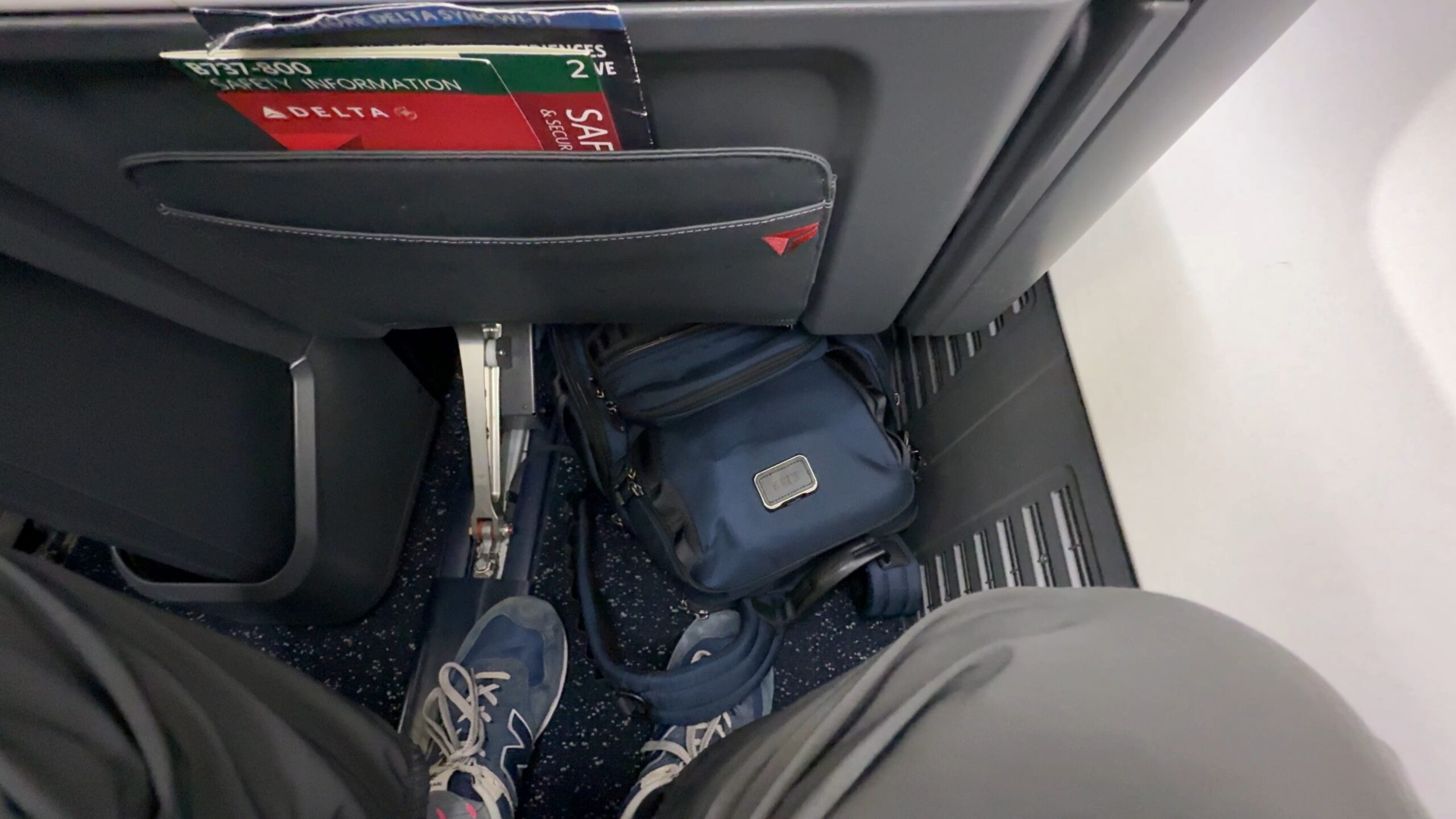
The personal item is the one bag every fare includes. On a full-fare ticket it rides along with a carry-on and nobody looks at it. On a basic fare it may be the only bag you are allowed, and at that point its size decides whether you walk on or pay at the gate.
The trouble is that there is no standard. American allows a bag nearly a third larger by volume than United does. Lufthansa’s published limit is 10 cm deep, which is thinner than most laptop backpacks when empty. Delta publishes no numbers at all. This guide puts the limits side by side, converts them to litres so they can be compared with how bags are actually sold, and works out what size to buy if you fly more than one airline.
What an airline means by “personal item”
A personal item is a bag that fits completely under the seat in front of you. That is the whole definition, and it is why the limits differ: airlines set the number to suit the tightest seats in their fleet.
A purse, a laptop bag, a small backpack, a briefcase, a tote and a camera bag all qualify. A roller bag qualifies if it is small enough, and “underseat” rollers are built for exactly this. What matters is the outside measurement, fully packed, including wheels, handles and whatever is stuffed in the front pocket.
The carry-on is the other, larger bag that goes in the overhead bin. If you are looking for those limits, they are in our carry-on size guide by airline. The two allowances are separate, and losing one does not change the other.
US and Canadian airlines
| Airline | Personal item limit (in) | Approx. volume | Notes |
|---|---|---|---|
| American | 18 × 14 × 8 | 33 L | The most generous published limit among the big US carriers. |
| Delta | None published | — | Must fit under the seat. Treat 17 × 13 × 8 as a safe working size. |
| United | 17 × 10 × 9 | 25 L | The tightest of the big three, and the one that matters most: Basic Economy on most domestic routes allows only this bag. |
| Southwest | 16.25 × 13.5 × 8 | 29 L | Sized to its 737 fleet. |
| JetBlue | 17 × 13 × 8 | 29 L | Blue Basic now includes a carry-on as well. |
| Alaska | 17 × 13 × 6 (verify) | 22 L | Alaska’s wording has changed over time; check before you fly. |
| Frontier | 18 × 14 × 8 | 33 L | The only free bag on every fare. Sizers at the gate are used. |
| Allegiant | 18 × 14 × 8 (verify) | 33 L | Only free bag; carry-on is paid. |
| Breeze | 17 × 13 × 8 | 29 L | Carry-on is paid on the cheapest fare. |
| Sun Country | 17 × 13 × 9 | 33 L | Carry-on is paid. |
| Air Canada | 17 × 13 × 6 (43 × 33 × 16 cm) | 23 L | Basic fares within North America: personal item only. |
| WestJet | 16 × 13 × 6 (41 × 33 × 15 cm) | 20 L | UltraBasic: personal item only. |
Spirit, for years the airline most associated with measuring personal items, stopped flying in May 2026. Its 18 × 14 × 8 limit lives on at Frontier and Allegiant.
European and other international airlines
| Airline | Personal item limit (cm) | In inches | Approx. volume | Notes |
|---|---|---|---|---|
| Ryanair | 40 × 30 × 20 | 15.7 × 11.8 × 7.9 | 24 L | The only bag on a basic fare. Raised from 40 × 25 × 20 in 2025. |
| easyJet | 45 × 36 × 20 | 17.7 × 14.2 × 7.9 | 32 L | The only free bag, but a big one. 15 kg limit. |
| Wizz Air | 40 × 30 × 20 | 15.7 × 11.8 × 7.9 | 24 L | Only free bag; 10 kg. |
| British Airways | 40 × 30 × 15 | 15.7 × 11.8 × 5.9 | 18 L | In addition to a cabin bag on every fare. |
| Lufthansa group | 40 × 30 × 10 | 15.7 × 11.8 × 3.9 | 12 L | The thinnest published limit of any major airline. A laptop sleeve, in effect. |
| Air France / KLM | 40 × 30 × 15 | 15.7 × 11.8 × 5.9 | 18 L | Combined weight limit with the cabin bag (12 kg in economy). |
Many long-haul carriers in the Gulf and Asia do not define a personal item in economy at all: you get one cabin bag, weighed, and a handbag or laptop bag is tolerated rather than promised. If you are connecting from a US airline onto one of them, pack as if the 7 kg cabin limit is real, because at some airports it is.
Why litres are the useful number
Bags are sold by volume. A “20-litre daypack” tells you more than three dimensions do, because a soft bag changes shape to fit the space. Converting the limits gives a simple ladder:
- 12 L — Lufthansa’s limit. A slim laptop bag.
- 18 L — British Airways, Air France, KLM. A small daypack.
- 20–25 L — United, Air Canada, WestJet, Ryanair, Wizz. A normal school-size backpack.
- 29–33 L — American, Southwest, JetBlue, Frontier, easyJet. A full travel daypack or an underseat roller.
A caution about the arithmetic: a bag’s listed volume and its outside dimensions rarely agree. Makers measure capacity with the bag stuffed round, and a round bag is deeper than its flat measurement. A “28 L” pack can easily be 10 inches deep when full. Depth is the dimension that fails at a sizer, so that is the one to watch.
The fares where the personal item is all you get
This is where the size limit stops being trivia.
- United Basic Economy — on most domestic and short-haul routes, a personal item only. A full-size carry-on brought to the gate is checked for the bag fee plus a handling charge. Transatlantic and transpacific Basic Economy fares do include a carry-on.
- Frontier, Allegiant, Breeze (cheapest fare), Sun Country — the personal item is free, everything else is priced, and the carry-on costs least when bought at booking and most at the gate.
- Air Canada Basic and WestJet UltraBasic — personal item only on North American routes.
- Ryanair, Wizz Air, easyJet — the basic fare is one under-seat bag. A second, larger cabin bag comes with priority boarding or a higher fare.
American, Delta, Southwest, JetBlue and Alaska include a carry-on on every fare. On those airlines the personal item limit is rarely tested unless the flight is full and the bins have closed.
What does not count against your allowance
US airlines generally do not count the following as either your carry-on or your personal item, although the list differs a little between carriers:
- A coat, jacket or hat, and an umbrella
- Food or duty-free bought after security
- Assistive and medical devices — a CPAP machine, a portable oxygen concentrator, crutches, a cane, a breast pump
- A child’s car seat or a collapsible stroller, and on most airlines a diaper bag when travelling with an infant
- A pet carrier does not get a pass: on most airlines it counts as your personal item or your carry-on, and you pay the pet fee as well
The practical use of this list is the coat. A jacket with big pockets is unregulated storage, and the heaviest small things you own — a power bank, a camera lens, a paperback — travel in it without being measured or weighed. European low-cost carriers are stricter about duty-free bags, so ask at the shop or fit the purchase inside your bag before boarding.
How bags are actually measured
Every dimension is an outside measurement of the packed bag. Wheels and handles count. So does a water bottle in a side pocket, and an overfilled front pocket is the usual reason a bag that “meets the size” does not drop into the sizer.
Two things work in your favour. First, a soft bag only has to fit, not measure: if it compresses into the frame without force, it passes, whatever the tag says. Hard-sided underseat cases have no such give. Second, the three numbers are not tied to a particular orientation. A bag that is 18 inches tall standing up is 18 inches long lying down, and under the seat is where it lies down.
The reverse also applies. A backpack measured empty tells you nothing. Pack it the way you would for a trip, stand it against a wall, and measure the depth at its thickest point with a book held flat against it. If that number is over 8 inches, it is an American-sized bag and not a United-sized one.
The space under the seat is not the same on every seat
The published limit describes what the airline will accept, not what a particular seat will hold. Three things change the space:
- Aisle and window seats are often narrower underneath than the middle seat, because the seat supports are not evenly spaced. On many narrow-body aircraft the middle seat has the widest opening.
- Entertainment and power boxes are bolted under some seats and take several inches of width. They are more common on older wide-bodies.
- Bulkhead rows have no under-seat storage at all, and neither do some exit rows. Everything goes overhead for take-off and landing, which on a personal-item-only fare means your single bag is out of reach when the seat-belt sign is on.
Regional jets are the other exception. Under-seat space on a 50- or 76-seat aircraft is lower than on a mainline jet, and a bag that is fine on a 737 can need a shove on a CRJ. If your trip includes a regional connection, size for that leg.
What it is like at the gate
Enforcement follows the business model. Airlines that include a carry-on on every fare have no reason to police the smaller bag, and their agents rarely do unless a bag is obviously a second carry-on. Airlines that sell the carry-on separately depend on that revenue, and they check: metal sizers at the gate, agents watching the boarding line, and gate prices set well above the online price to make the point. On European low-cost carriers the check is routine on busy routes and the fee is charged per bag, per flight.
When a bag is challenged, the test is whether it goes into the sizer without being forced. Taking out a jacket or a laptop and carrying it is allowed and often enough. Arguing about the tape measure is not a winning strategy; the sizer is the rule.
Which size to buy
If you fly one airline, buy to its limit. If you fly several, there are three sensible targets.
Clears everything in North America: about 16 × 13 × 8 inches
That fits American, Delta, Southwest, JetBlue, Frontier and Allegiant with room to spare. United is the awkward one, because its 10-inch width is narrower than everyone else’s 13 or 14. A soft backpack of roughly 16 × 12 × 8 that is not packed to bursting will sit in United’s sizer on its side; a structured bag 13 inches wide will not. If United Basic Economy is a regular part of your travel, choose a bag that is narrow and deep rather than wide and flat, and keep it near 22–24 litres.
Clears Europe’s low-cost carriers: 40 × 30 × 20 cm
About 15.7 × 11.8 × 7.9 inches and 24 litres. This is now the common Ryanair and Wizz limit and sits comfortably inside easyJet’s. A large number of bags are sold to exactly this size. It also clears every US limit except, again, United’s width by under two inches — which a soft bag absorbs.
One bag for both: a soft 20–24 L backpack, no frame, no wheels
There is no rigid bag that satisfies every airline in both tables. A frameless backpack in the low twenties of litres, with compression straps and a flat laptop sleeve against the back, comes closest, because it can be made thinner by taking things out. For Lufthansa’s 10 cm it will only comply half empty, but Lufthansa also includes a cabin bag on all but its lightest fares, so the personal item there is a laptop bag in any case.
Wheels cost space. An underseat roller loses two to three inches of its length to wheels and handle housing, so a roller at the 18-inch limit holds noticeably less than a backpack at the same limit. It is the better choice if you cannot carry weight on your shoulders, and not otherwise. Our carry-on travel backpack guide covers the larger bags; most makers in it also sell a personal-item size.
Travelling on a personal item alone
Twenty-four litres is enough for a long weekend and, with laundry, for a week somewhere warm. The method is the same as any one-bag packing list, only stricter:
- Wear the bulk. Boots, jacket and the heaviest layer go on your body at the airport.
- Two pairs of shoes at most, one of them on your feet.
- Three days of clothes, whatever the length of the trip, in fabrics that dry overnight. A compression cube earns its place here more than in any larger bag.
- Solid or decanted toiletries. The liquids bag is thick; keep it small and keep it at the top for security.
- One charger that does everything. A compact multi-port charger and a short cable set replace a pouch of bricks. See travel adapters and power banks, and remember that power banks must stay in the cabin with you, which on this kind of trip they will.
- Leave depth to spare. Pack the bag to seven inches, not eight. The spare inch is what gets it into the sizer when someone is watching.
More on the general approach is in our carry-on only packing guide.
Frequently asked questions
Is a backpack a personal item or a carry-on?
Either. The airline does not care what kind of bag it is, only whether it fits under the seat. A 20-litre daypack is a personal item. A 40-litre travel pack is a carry-on, and on a personal-item-only fare it will be charged as one.
Can I bring a purse as well as a personal item?
No. A purse is a personal item. If you have a backpack and a purse on a one-bag fare, the purse has to go inside the backpack before you board. On a normal fare, the purse is the personal item and the backpack is the carry-on.
Do airlines weigh personal items?
US airlines almost never do. Outside the US, weight limits are common and sometimes combined across both cabin bags: Air France and KLM allow 12 kg in total in economy, easyJet allows 15 kg for its under-seat bag, Wizz Air 10 kg. Asian and Gulf carriers are the most likely to put cabin bags on a scale at check-in.
What happens if my personal item is too big?
On an airline that includes a carry-on, usually nothing, or the bag is treated as your carry-on. On an airline that charges for carry-ons, you pay the gate price for one, which is the most expensive way to buy it. On a full flight the bag may also be checked to your destination, so keep medication, documents, keys and batteries where you can pull them out quickly.
Does a laptop bag count if I also have a backpack?
Yes. Two bags is two bags. The one exception is a fare that includes both a carry-on and a personal item, where the laptop bag is the personal item and the backpack goes overhead.
Which seat has the most under-seat room?
It varies by aircraft, but on many single-aisle jets the middle seat has the widest gap between supports. Avoid bulkhead rows on a one-bag fare, since nothing may stay on the floor for take-off and landing.
Limits were compiled in September 2026 and airlines change them without announcement. The airline’s own carry-on page is the authority; check it when you book and again before you fly.