
Some links below are affiliate links. If you buy through one, we earn a commission at no extra cost to you. It never changes a verdict — here is how that works.
How this guide was built: it compares manufacturer-published specifications and current listings. Comfort is personal and we have not run a test programme on these products; nothing below claims otherwise.
Long-haul comfort comes down to four problems: your head falls over when you doze, the seat-back screen only takes wired headphones, your legs swell after hours of sitting, and hotel rooms at the other end are noisy. Each has a small, packable fix. None is essential, so the order below is roughly the order in which they earn their space in a carry-on.
The picks at a glance
| Product | Type | Key manufacturer specs | Best for |
|---|---|---|---|
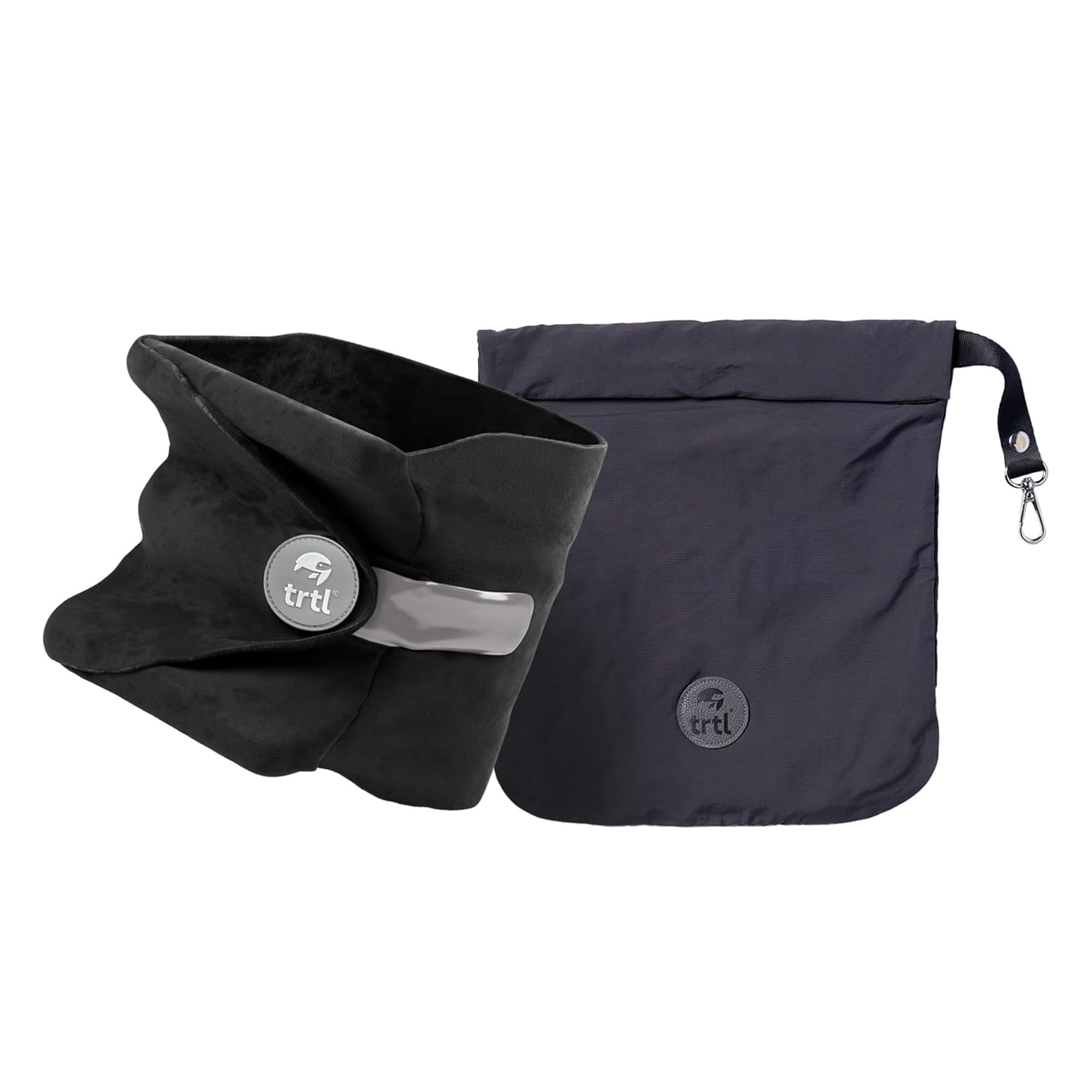
| Trtl Pillow | Wrap-style neck support | Fleece wrap with an internal support frame, machine washable, packs flat | Side-leaners; travellers short on bag space |
| Cabeau memory-foam neck pillow | U-shaped pillow | Memory foam, adjustable front clasp, removable washable cover, about 11 × 11 × 5 in | Those who want all-round support and don’t mind the bulk |
| Twelve South AirFly SE | Bluetooth transmitter | 3.5mm plug, one pair of headphones, 20+ hours per charge | Solo travellers with AirPods or any Bluetooth headphones |
| Avantree Relay | Bluetooth transmitter | 3.5mm plug, two headphones at once, aptX Adaptive/HD, about 25 hours | Couples sharing one screen |
| Copper-infused compression socks | Knee-high compression socks | 15–20 mmHg graduated compression, nylon/spandex blend | Flights over about four hours |
| SNOOZ Go | Travel sound machine | Six sounds (fan, white and pink noise), rechargeable, doubles as a Bluetooth speaker | Light sleepers in hotels |
Neck pillows: wrap or U-shape?
The classic U-shaped pillow cushions your neck but does little to stop your head tipping forward or sideways, which is what wakes most people. The two designs here tackle that differently.
Trtl Pillow — support on one side, packs flat
The Trtl is a fleece scarf with a curved plastic support hidden inside. You position the support on the side you lean toward and wrap the fleece around to hold it. It weighs very little and packs flat against a laptop, which a foam pillow never will. It supports one side only, so it suits people who settle into a single position; and fleece around the neck is warm, which is welcome on a cold cabin and less so on a hot one. Check the Trtl Pillow on Amazon.
Cabeau memory-foam pillow — all-round support
A taller memory-foam U with raised sides and an adjustable front clasp that closes the gap under the chin, so the head is held from three directions. The cover zips off for washing. The trade-off is volume: even compressed into its bag it is the bulkiest item on this page, so it tends to ride clipped to the outside of a bag. Check the Cabeau pillow on Amazon.
Window or aisle? If you book windows and lean on the wall, the Trtl is enough. If you sleep upright in an aisle or middle seat, the Cabeau’s chin support matters more.
Bluetooth adapters for seat-back screens
Most seat-back entertainment still has only a 3.5mm headphone jack. A Bluetooth transmitter plugs into it and pairs with the wireless headphones you already own. Some newer aircraft now offer Bluetooth pairing at the seat, but it is far from universal and varies by aircraft even within one airline, so a transmitter remains the reliable answer.
Twelve South AirFly SE — one traveller
The simplest version: one plug, one pair of headphones, 20-plus hours per charge by the maker’s figure — enough for the longest flights without recharging. Twelve South’s Duo and Pro models add a second pair of headphones if you need it. Check the AirFly SE on Amazon.
Avantree Relay — two people, one screen
Streams to two sets of headphones at once, supports aptX Adaptive and aptX HD for lower latency with compatible headphones, and is rated for about 25 hours. AirPods and most other earbuds use AAC or SBC rather than aptX; they will still work, just without the low-latency mode. Check the Avantree Relay on Amazon.
Two practical notes: a few older aircraft use a two-prong socket, so a cheap dual-prong airline adapter is worth keeping with the transmitter; and these also work with gym equipment, a Nintendo Switch or a hotel TV with a headphone output.
What about headphones?
On a plane, active noise cancellation does more for comfort than any other headphone feature, because it removes the constant engine drone that makes you turn the volume up. Bass-heavy headphones without ANC — the Skullcandy Crusher Evo, with its 40-hour battery and adjustable haptic bass, is a popular example — are enjoyable on the ground but are not the right tool for a cabin. If you are buying headphones mainly for flying, buy ANC first.
Compression socks
Graduated compression socks are tightest at the ankle and ease toward the knee, which helps push blood back up the leg while you sit. For healthy travellers, 15–20 mmHg is the usual over-the-counter level and the one most often suggested for flights of four hours or more to reduce swelling. Check these 15–20 mmHg knee-high compression socks on Amazon.
Buy by calf and shoe measurement, not guesswork — a sock that is too tight at the top band works against you. The “copper-infused” part of many listings is marketing; the compression is what does the work. If you have a history of blood clots, circulation problems, diabetes, recent surgery or are pregnant, ask your doctor which compression level, if any, is right for you before a long flight. Socks complement, and do not replace, getting up to walk and staying hydrated.
Sleep at the other end: a travel sound machine
The SNOOZ Go is a palm-sized rechargeable sound machine with six sounds — fan, white and pink noise variations — that also works as a Bluetooth speaker. It earns its space if thin hotel walls or street noise routinely cost you sleep, or if you travel with a child who sleeps with white noise at home. If you already sleep with earbuds, a white-noise app does the same job for nothing.
What to pack for which flight
- Under four hours: headphones and, if you use seat-back screens, a Bluetooth transmitter. Skip the rest.
- Overnight long-haul in economy: neck pillow, compression socks, transmitter, plus an eye mask and earplugs.
- Carry-on only: the Trtl rather than a foam pillow; the AirFly SE is the smallest transmitter.
- Travelling as a pair: the Avantree Relay, or a two-headphone AirFly.
Related: the carry-on only packing guide · travel adapters and power banks · carry-on size rules by airline.
Frequently asked questions
Can I use Bluetooth headphones on a plane?
Yes. Airlines permit Bluetooth devices in flight; some ask you to switch them off for take-off and landing. The obstacle is the seat-back screen, which usually needs a wired connection — hence the transmitter.
Do neck pillows count as a personal item?
Most airlines ignore a pillow worn or clipped to a bag, but a few low-cost carriers count everything. If your fare is strict, pick a pillow that packs inside your bag.
Are compression socks safe for everyone?
Mild over-the-counter compression is fine for most healthy adults. People with arterial disease, neuropathy, skin conditions on the legs or a clot history should get medical advice first.