
1. Intro: The Architecture of Modern Travel
The trajectory of modern travel has shifted irrevocably from the era of the trunk and the checked suitcase to the age of the “One-Bag” philosophy. This transition is not merely a reaction to the predatory baggage fees of budget airlines or the increasing incompetence of global baggage handling systems; it is a fundamental shift in the identity of the traveler. The modern traveler is no longer a passive passenger but an active, mobile node in a global network. They are “digital nomads,” remote executives, and tech-centric creators who carry their livelihoods on their backs. In this new paradigm, the backpack is not just a vessel for clothing; it is a mobile office, a security deposit box, and a lifestyle statement.
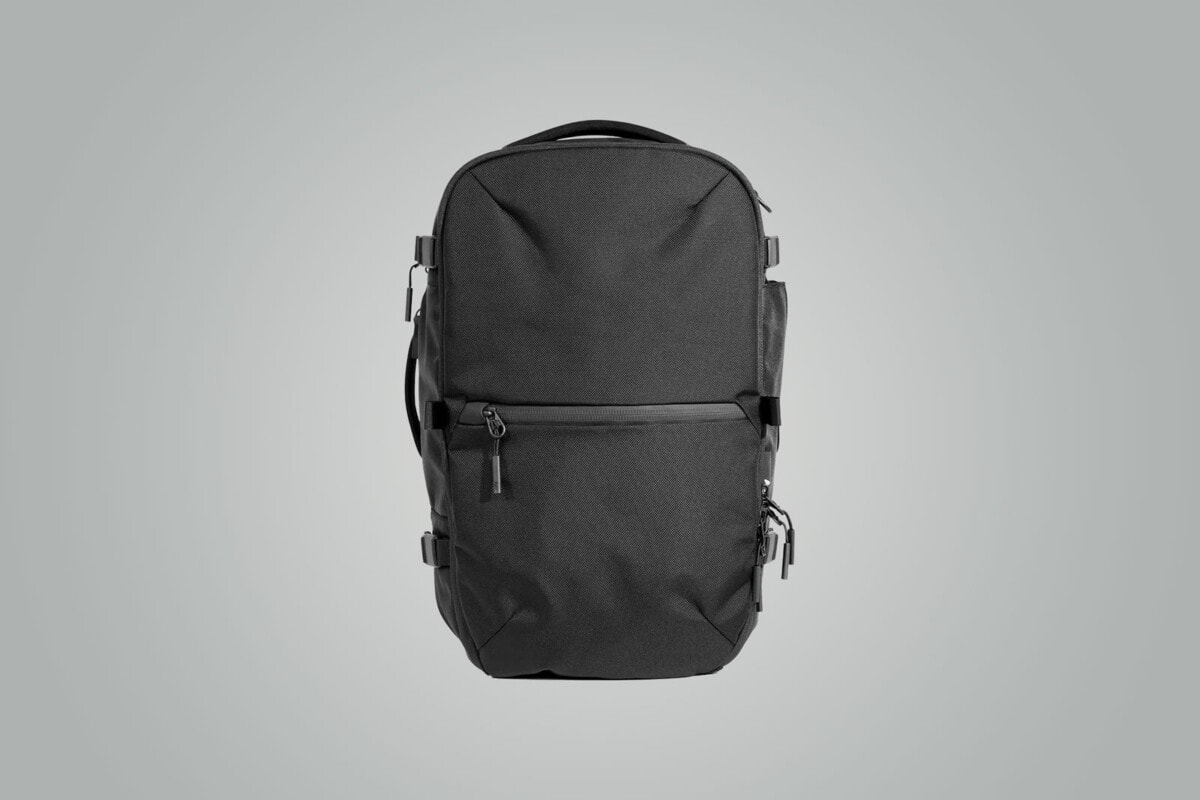
Within this competitive ecosystem, the San Francisco-based design studio Aer has carved out a formidable niche. Since its inception, Aer has focused relentlessly on the intersection of gym utility and office professionalism, eventually graduating to travel gear that feels at home in a start-up boardroom and a hostel lobby alike. The release of the Aer Travel Pack 3 (TP3) marks the third generation of their flagship travel product, a bag that has arguably defined the “tech-travel” category.
2. Methodology and Testing Logic
To provide a review of sufficient depth and integrity, our analysis framework moves beyond the “unboxing” phase into rigorous, scenario-based evaluation. The insights presented here are synthesized from a matrix of data points including technical specification analysis, long-term durability reports extending over 18 months of continuous use, and comparative stress testing against competitor products.
The Testing Protocol includes:
- Load Carriage Dynamics: Evaluating the efficacy of the new load-lifter system under varying weights (15 lbs, 20 lbs, and 25 lbs) to determine the point of critical failure in comfort.
- Volumetric Efficiency: Analyzing the “Real World” packing volume versus the stated 35-liter capacity, specifically investigating the impact of the “tech organization” panels on the main compartment’s usability.
- Airline Compliance: Cross-referencing dimensions with sizer bins for major domestic (US) and international carriers to determine strict carry-on vs. personal item viability.
- Material Degradation Analysis: Comparing the wear patterns of 1680D Cordura, VX-42 X-Pac, and Ultra 400X over time, focusing on abrasion resistance, delamination risks, and aesthetic aging.
This rigorous approach ensures that the conclusions drawn are not merely observations of features, but assessments of function in the chaotic reality of global travel.1
3. Design Philosophy and Aesthetic Identity
3.1 The “Tech-Minimalist” Visual Language
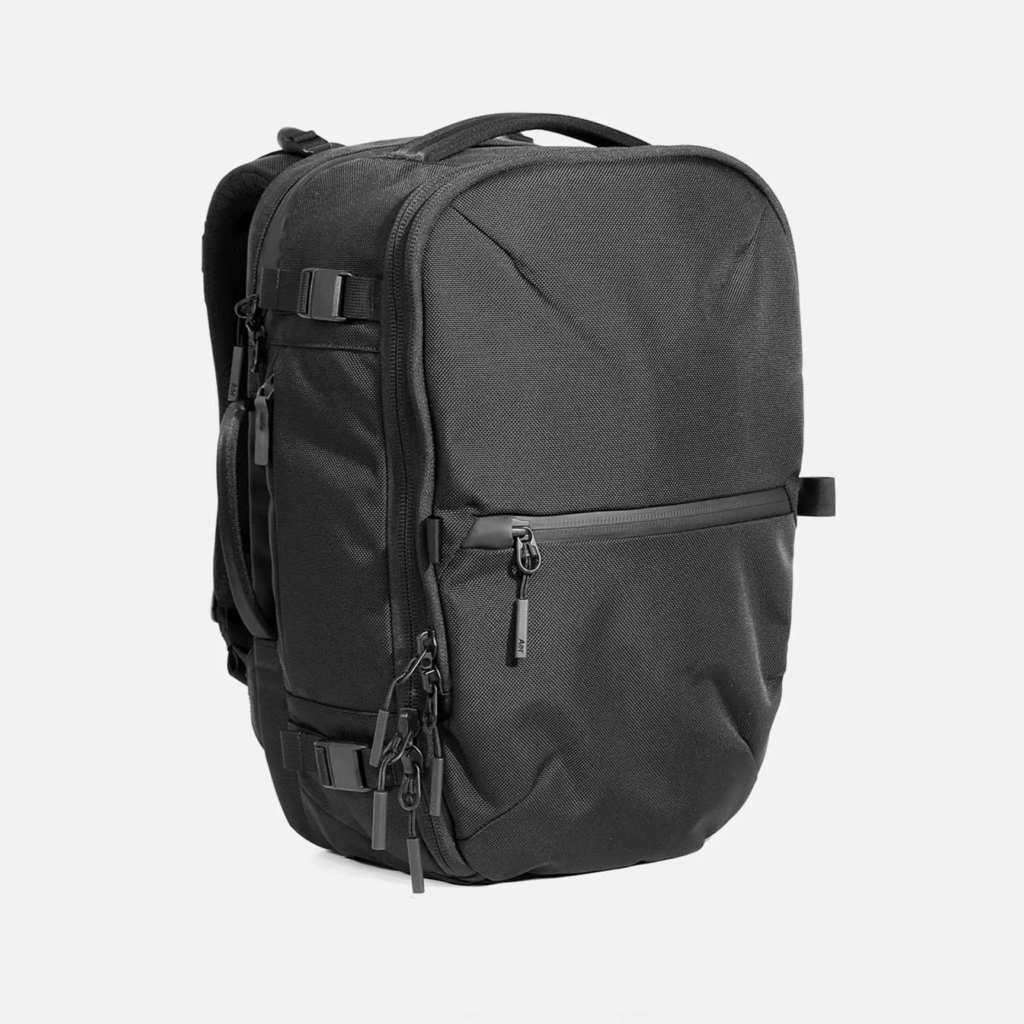
Aer’s design language is instantly recognizable: it is the aesthetic of the modern urban environment—structured, monochromatic, and architectural. Unlike “heritage” brands (e.g., Filson) that rely on canvas and leather to evoke a sense of nostalgic exploration, or “outdoor” brands (e.g., Osprey, Patagonia) that utilize bright colors and complex external lashing systems, the Aer TP3 is unapologetically industrial.1
The bag is designed to look as appropriate in a WeWork conference room in London as it does in an overhead bin on a flight to Tokyo. This versatility is achieved through a “clean face” design. The front of the bag is largely devoid of dangling straps or aggressive branding. The logo is a subtle tag, not a billboard. The profile is boxy and rectangular, maximizing volume efficiency while signaling a “luggage” utility rather than a “hiking” vibe.
A critical aspect of this aesthetic is the bag’s ability to stand upright. Through the use of a rigid internal framesheet and structured sidewalls, the TP3 maintains its verticality even when empty.1 This is a subtle but profound quality-of-life feature for the traveler. When waiting in a check-in line, working at a coffee shop, or accessing gear in an airport lounge, the bag sits by the user’s leg like a dedicated cabinet, rather than slumping onto the dirty floor like a rucksack. This “standing” capability reinforces the bag’s identity as a mobile workstation.4
3.2 Functional Segmentation: The Three-Zone Logic
The architecture of the TP3 is built around a strict segregation of duties. Unlike “bucket” bags where all items share a single cavernous space, the TP3 enforces a discipline of organization through three distinct depth zones:
- The Admin Interface (Front): A highly organized panel for small tech, documents, and quick-access essentials.
- The Cargo Hold (Center): A clamshell-opening main compartment for clothing and toiletries.
- The Tech Vault (Rear): A heavily padded, suspended compartment for laptops and tablets, positioned against the user’s back for weight management and security.
This segmentation allows the user to transition between “traveler mode” and “worker mode” without cross-contamination. One can extract a laptop and charger for a meeting without ever exposing their packing cubes or toiletries to the room—a crucial professional boundary that many travel backpacks fail to respect.1
4. Material Science: The Fabric Ecosystem
The choice of material is the single most significant variable for the potential buyer, influencing not just the weight and durability of the pack, but its tactile feel, acoustic signature, and weather resistance. Aer offers the TP3 in three primary fabrics, each creating a distinct user experience. We will analyze the 1680D Cordura® Ballistic Nylon in primary depth as requested, while contrasting it with the X-Pac and Ultra variants to provide context.
4.1 1680D Cordura® Ballistic Nylon (The Standard)
- Weight: 4.12 lbs (1.87 kg) 1
- Weave: Basket weave (2×2)
- Origin: Originally developed by DuPont for military flak jackets (hence “Ballistic”) to protect airmen from flying debris.
Analysis:
The standard TP3 utilizes 1680D Cordura Ballistic Nylon. This is a heavy-duty, synthetic nylon fabric with a basket weave that offers exceptional tensile strength and abrasion resistance.
- Durability: In the hierarchy of backpack materials, 1680D is “overkill” for most civilian applications. It is virtually impossible to tear through normal use. It resists scuffs from concrete floors, asphalt, and baggage carousels effectively. Reports of the bag looking “practically new” after 18 months of abuse are largely due to this material’s resilience.2
- Aesthetics and Aging: The fabric has a matte finish and a slight texture. Over time, it softens slightly but retains its color well. Unlike coated fabrics, it does not develop “patina” in the traditional sense, but nor does it crack or delaminate.
- Dust and Lint: The coarse weave of the 1680D can trap dust and lint more easily than smoother laminates. However, it cleans up easily with a damp cloth.6
- Water Resistance: The fabric is treated with a DWR (Durable Water Repellent) coating and has a polyurethane (PU) backing. However, because it is a woven fabric, water can eventually work its way through the weave under sustained heavy pressure or torrential rain. It is water-resistant, not waterproof.7
4.2 VX-42 X-Pac™ (The Tech Upgrade)
- Weight: ~3.9 lbs (1.77 kg) 8
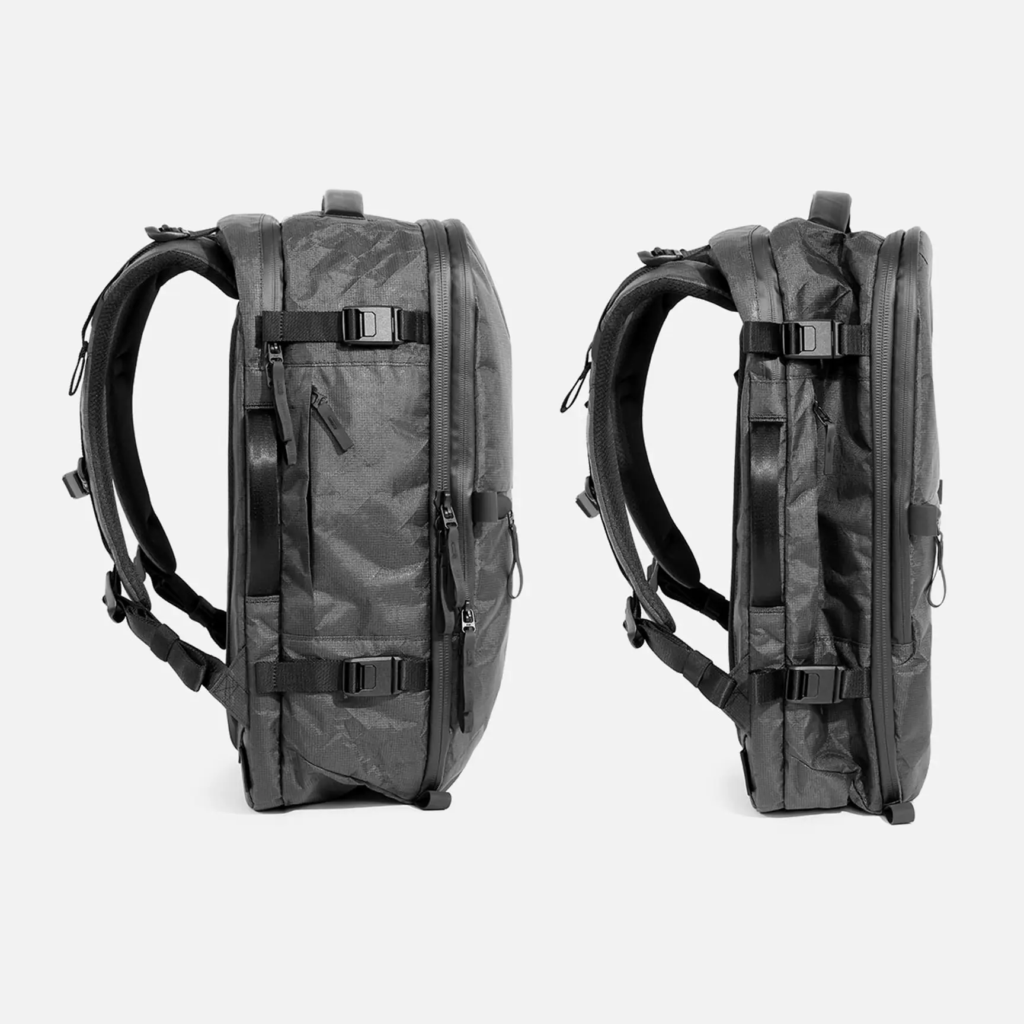
- Structure: 4-layer laminate (Nylon face, X-Ply polyester mesh, PET film, Taffeta backing).
Analysis:
X-Pac is a sailcloth technology adapted for carry goods.
- The Trade-off: It is lighter than Cordura and inherently waterproof due to the laminate layer (though the bag’s seams are not taped). It features YKK AquaGuard zippers which provide a weather seal but are stiffer to operate.8
- The Interior: A major selling point of the X-Pac version is the high-visibility orange liner. In deep, dark airplane cabins, this contrast makes finding a black USB cable or a dark adapter significantly easier than in the standard grey interior of the Cordura version.9
- Noise: X-Pac has a distinct “crinkle” sound when manipulated, which some users find less premium than the silent flow of Cordura.11
4.3 Ultra 400X (The Performance Apex)
- Weight: 3.7 lbs (1.68 kg) 12
- Structure: Ultra High Molecular Weight Polyethylene (UHMWPE) composite.
Analysis:
This is the cutting edge of material science, offering a strength-to-weight ratio 15x greater than steel.
- Durability vs. Cosmetics: While physically stronger, the Ultra fabric is prone to aesthetic scuffing and wrinkling immediately upon use. It does not maintain the “pristine” look of Ballistic Nylon.14
- The Dust Issue: Users have reported the rubberized face of the Ultra fabric acts as a dust magnet, looking dirty faster than the other variants.15
- Delamination Anxiety: While Ultra is more stable than older laminates, long-term delamination (separation of layers) remains a theoretical concern in the ultralight community, though Aer’s implementation is too new to show widespread failure.16
Table 1: Comparative Material Specifications
| Feature | 1680D Cordura® Ballistic Nylon | VX-42 X-Pac™ | Ultra 400X |
| Primary Focus | Durability & Feel | Weatherproofing & Structure | Weight Reduction & Strength |
| Weight (35L Bag) | 4.12 lbs | ~3.90 lbs | 3.70 lbs |
| Abrasion Resistance | Excellent | High | Extreme |
| Water Resistance | Moderate (DWR + PU) | High (Laminate + AquaGuard) | Extreme (Laminate + AquaGuard) |
| Hand Feel | Soft, textured, fabric-like | Stiff, smooth, technical | Crisp, rubberized, waxy |
| Interior Color | Cool Grey | High-Vis Orange | Grey / Lime Green accents |
| Zipper Type | YKK Racquet Coil (Smooth) | YKK AquaGuard (Stiff) | YKK AquaGuard (Stiff) |
| Price Premium | Base Price ($249) | +$30 ($279) | +$50 ($299) |
5. Feature Analysis: The Exterior Chassis
5.1 The Load Lifter Upgrade: Correcting Past Mistakes
The defining criticism of the previous Aer Travel Pack 2 was its carry comfort. When fully loaded to 35L, the bag had a tendency to pull away from the user’s upper back, creating a lever effect that strained the shoulders. The Aer Travel Pack 3 addresses this directly with the introduction of load lifters.1
- Mechanism: Load lifters are adjustable straps connecting the apex of the shoulder harness to the upper body of the pack.
- Physics of Comfort: By tightening these straps, the user pulls the pack’s center of mass forward, aligning it with their own spinal column. This transfers the vector of the weight from a backward pull (which engages the trapezius and shoulders) to a downward push (which is better supported by the skeletal structure).
- Real World Impact: For a bag that can weigh 25+ lbs when loaded with tech, this is transformative. It changes the bag from a “short haul” transporter to a viable “long haul” walker. Users report the ability to carry the bag for hours without the backward-dragging sensation that plagued the TP2.18
5.2 The Harness and Back Panel
The shoulder straps utilize a dual-density foam that is firm but compliant. They are contoured in an “S” curve to navigate the chest anatomy comfortably for both male and female users, though fit on smaller frames remains a point of contention (discussed in Section 8).
- Sternum Strap: The sternum strap features a magnetic fastener (likely Fidlock V-Buckle or similar). It is easily adjustable on a rail system. The magnet allows for one-handed operation—a satisfying “click” that signals security.1
- Back Panel: The back panel uses a suspended mesh design with a central air channel. While no backpack completely eliminates “sweaty back syndrome,” the airflow channel does mitigate heat buildup compared to a flat foam panel.2
5.3 Compression Straps and Magnetic Hardware
The TP3 features four side compression straps, two on each side.
- Innovation: Aer has replaced standard plastic side-release buckles with magnetic fasteners. These slide to unlock and snap together magnetically.
- Usability: This system is polarizing. It is undeniably faster and more premium-feeling than standard buckles. However, users report that the magnets can disengage unintentionally if the bag is dragged forcefully (e.g., pulling it out from under an airplane seat), leading to flailing straps.2
- Zipper Path Correction: Crucially, the compression straps are positioned away from the zipper line of the front admin panel. On the TP2, the straps blocked access to the front pocket; on the TP3, you can access your tech essentials without unclipping the compression straps—a major workflow improvement.19
5.4 The Water Bottle Pocket
The external water bottle pocket addresses a common travel bag failure point: the lack of secure hydration storage.
- Design: The pocket lays flat against the bag when empty, secured by a zipper. When unzipped, an elastic mesh gusset expands to accept a bottle.
- Capacity: It has been field-tested to fit a standard 1 Liter (32oz) Nalgene or a thick 24oz Yeti Rambler. This capacity is a “make or break” feature for many travelers.20
- The “Crush” Issue: It must be noted that the pocket expands outward but also competes slightly for internal volume. If the main compartment of the bag is packed to bursting (the “brick” state), the pressure against the sidewall makes inserting a water bottle extremely difficult. It often requires two hands and significant force to wedge a bottle back in.9
5.5 Handles and Pass-throughs
- Grab Handles: The bag features thick, tubular padded handles on the top and both sides. These are essential for the “overhead bin press,” allowing the user to manipulate the heavy load comfortably from any angle. The padding prevents the nylon webbing from cutting into the hand.19
- Luggage Pass-through: A dedicated strap on the back panel allows the TP3 to slide over the handle of a rolling suitcase. The pass-through is oriented for the bag to sit vertically (upright). This is the preferred orientation for stability, keeping the center of gravity low and centered over the roller’s wheelbase.1
6. Feature Analysis: The Interior Architecture
6.1 The Front Admin Panel: The Mobile Desk
The frontmost compartment is the “brain” of the bag. It is deep and rich with organization.
- Inventory: It includes a mix of slip pockets (sized for hard drives, mice, and power banks), pen slots, and a zippered mesh pocket for loose items (USB sticks, pills). It also features a document sleeve that fits an iPad or a folded itinerary.
- Implication: This panel has its own dimension (depth). Even when empty, it gives the bag a “turtle shell” profile. For the “one-bag” traveler who carries minimal tech, this space can feel like wasted volume. However, for the photographer or developer carrying a suite of peripherals, this panel eliminates the need for a separate tech pouch (like the Peak Design Tech Pouch), saving roughly $60 and 0.5 lbs of weight.23
- Critique: Accessing the bottom of this deep pocket can be tight when the main compartment behind it is fully loaded. The volume of the main compartment bulges forward, compressing the admin panel space.9
6.2 The Main Compartment: The Cargo Hold
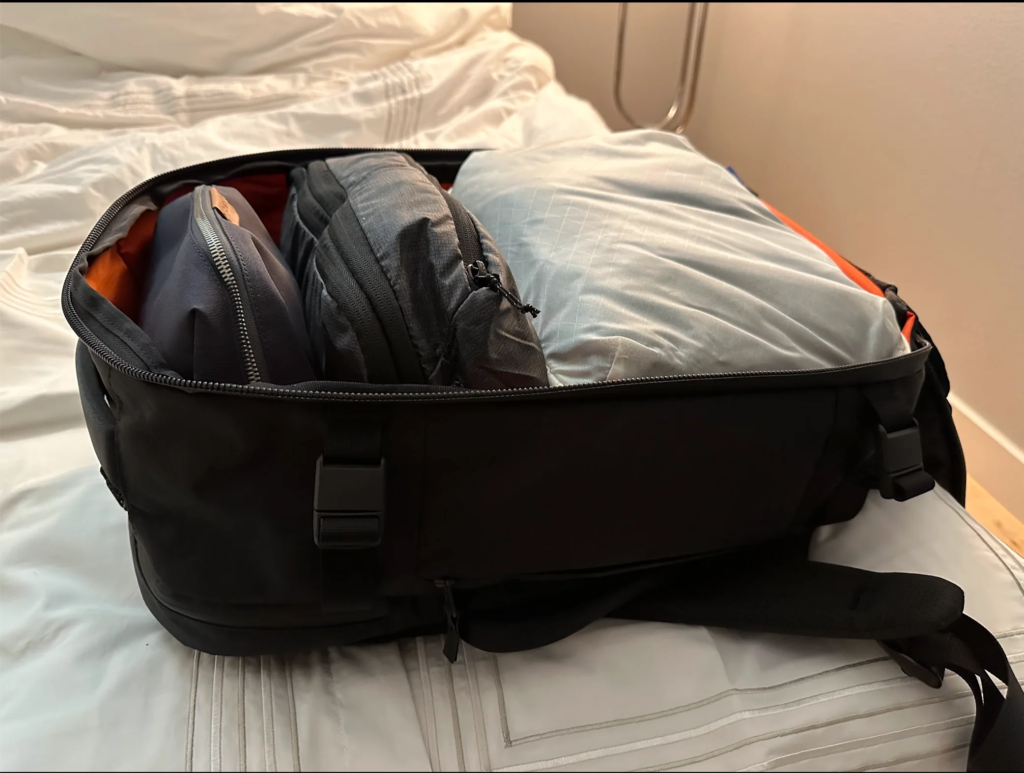
The core of the TP3 is its luggage-style, clamshell opening. This allows the bag to lie completely flat, enabling the user to pack it like a suitcase rather than stuffing it like a hiking sack.
- Volume Reality: While the bag is rated at 35L, the “bucket” space for clothes feels closer to 25-28L. This is because the volume is shared with the admin panel in front and the laptop vault in the rear.
- Packing Strategy: The space is rectangular and optimized for packing cubes. A standard loadout for a 5-day trip would include one medium compression cube (pants, shirts) and one small tube cube (socks, underwear), placed alongside a dopp kit.
- Structure: The sidewalls are rigid, preventing the “slump.” This makes packing significantly easier as the bag holds its shape while you arrange your items.1
6.3 The Laptop Vault: The Safe Room
Positioned directly against the wearer’s back is the laptop compartment.
- Suspension System: The pocket features a substantial “false bottom.” The laptop sleeve ends roughly 1.5 to 2 inches above the physical bottom of the bag. If the user drops the bag heavily onto a concrete floor, the laptop never makes contact. This feature alone provides peace of mind that justifies the bag’s price for professionals carrying expensive MacBooks.1
- Capacity: It easily swallows a 16-inch MacBook Pro. The compartment is also heavily padded on both sides, ensuring that the pressure from a fully stuffed main compartment does not crack the laptop screen—a common failure in lesser bags.
- Trade-off: This heavy padding and false bottom structure contribute significantly to the bag’s base weight and stiffness.
6.4 Hidden and Quick-Access Pockets
- The Smart Tracker Pocket: Buried inside the main compartment is a small slip pocket specifically designed for an Apple AirTag or Tile tracker. This allows for discreet tracking of the bag without the tracker dangling visibly.19
- The Top Stash Pocket: Located near the top handle is a small zippered pocket lined with soft microfiber. It is designed for sunglasses or a phone.
- Flaw: This pocket hangs loosely into the main compartment volume. If the main compartment is overpacked, this pocket gets crushed, making it hard to retrieve sunglasses without damaging them or wrestling the zipper.2
7. Performance Analysis: 35L vs. 28L
One of the most frequent questions for potential buyers is the choice between the standard Travel Pack 3 (35L) and the Travel Pack 3 Small (28L). The decision is not merely about volume; it is about body mechanics and airline compliance.
7.1 The Travel Pack 3 (Regular – 35L)
- Dimensions: 21.5″ (L) x 13″ (W) x 9″ (D)
- Target User: Travelers over 5’10” (178cm), or those on indefinite trips requiring maximum capacity.
- Carry Dynamics: At 21.5 inches long, this bag maximizes the vertical allowance of US domestic carry-on limits. On a shorter torso, this length is problematic. The bottom of the bag may hit the glutes, causing the bag to bounce while walking, and the hip belt (if used) may sit too low to be effective.24
- Airline Status: Strict Overhead Bin only. It will almost never fit legally under a seat.25
7.2 The Travel Pack 3 Small (28L)
- Dimensions: 19″ (L) x 13″ (W) x 7.5″ (D)
- Target User: Travelers under 5’9″, weekend trippers, and those needing “Personal Item” compliance on lenient airlines.
- Carry Dynamics: The 19-inch length is far more compatible with average torsos. It sits higher on the back, looking less like a “turtle shell” and more like a large daypack. It transitions much better to being an EDC (Everyday Carry) bag at the destination.26
- Airline Status: “Unofficial” Personal Item. It fits under the seat of most major carriers (Delta, United, BA), although it may stick out slightly into the footwell. It is technically too large for strict budget sizers (Ryanair), but its visual profile is small enough to often avoid scrutiny.2
Table 2: Sizing and Fit Matrix
| Feature | Travel Pack 3 (Regular) | Travel Pack 3 Small |
| Volume | 35 Liters | 28 Liters |
| Ideal Torso Length | Large / Tall | Small / Medium |
| EDC Usability | Low (Too bulky) | Medium (Acceptable) |
| Under Seat Fit | Impossible | Possible / Tight |
| Weight (Cordura) | 4.12 lbs | 3.79 lbs |
| Packing Duration | Indefinite / 7+ Days | 2-4 Days / Minimalist |
8. Real-World Travel: “Experienced Traveler” Perspective
8.1 The Airport Protocol
In the security line, the TP3 excels. The separate laptop compartment allows for the “one-zip draw,” removing the computer for scanning in seconds without exposing underwear or toiletries. The handles make swinging it onto the conveyor belt effortless.
- The Zipper Confusion: A recurring friction point in the field is the proximity of the main compartment zipper and the laptop compartment zipper. They run parallel and close to each other. In a rush, it is common to grab the wrong zipper pulls, opening the clothes compartment when you meant to grab the laptop. Experienced users solve this by adding different colored paracord pulls to distinguish them.19
8.2 Transit and Walking
With the load lifters engaged, the TP3 carries surprisingly well for a frameless pack (it has a framesheet, but no metal stays). The center of gravity stays close to the spine.
- Sweat Management: The mesh back panel is adequate, but in humid climates (e.g., Bangkok or Singapore), the large surface area contact will result in a sweaty back. This is unavoidable with this class of travel pack.2
8.3 Durability in the Wild
Longitudinal reports confirm the “bombproof” reputation of the 1680D Cordura. After 150+ flights, users report zippers breaking in (becoming smoother) rather than breaking down. The fabric resists the grime of bus floors and the abrasion of overhead bins. However, the external Hypalon (rubberized) touchpoints on the handle attachments can show wear faster than the nylon itself.2
9. Competitive Landscape and Benchmarking
To understand the TP3’s value, it must be contextualized against its primary rivals.
9.1 Aer TP3 vs. Peak Design Travel Backpack 45L
- Access: Peak Design (PD) offers side access zippers, allowing the user to swing the bag around to grab a camera without taking it off. Aer lacks this; it is strictly a “take it off to access” bag.
- Expansion: PD features a complex expansion/compression system (30L to 45L). Aer is fixed at 35L (with minor compression).
- Comfort: Critical Distinction: The Aer TP3 is widely considered superior in comfort. The PD straps are thinner and less padded, often cutting into shoulders under heavy loads. The Aer harness is plush, dense, and supported by load lifters that function more effectively.29
- Verdict: Choose Peak Design for photography (side access) and volume versatility. Choose Aer for carry comfort and tech organization.
9.2 Aer TP3 vs. Tortuga Travel Backpack 40L
- Harness: Tortuga offers a fully adjustable suspension system (the yoke moves up and down for torso length) and includes a massive, padded hip belt. It is a true hiking-style harness on a travel bag.
- Volume: Tortuga is a “max carry-on” bucket (40L). It holds significantly more clothing than the Aer TP3 (35L), which loses space to tech organization.
- Verdict: Choose Tortuga if your primary load is clothing and you are walking miles with the bag. Choose Aer if you need to work out of the bag and carry significant tech.30
10. Critique: The Downsides and Friction Points
Despite its accolades, the TP3 is not without flaws.
- Weight: The “elephant in the room” is the base weight. At 4.12 lbs (Cordura), the bag eats up nearly 30% of a 7kg (15.4 lb) carry-on limit common on Asian and Australian budget airlines. It is an “over-engineered” bag. Light packers may find the weight penalty unacceptable.18
- The “Strappiness”: Between the load lifters, sternum strap, four compression straps, and shoulder adjustment straps, the bag can feel like a nest of webbing. When sitting at your feet in a meeting, it looks messier than a sleek briefcase unless you meticulously tidy the straps.2
- Zipper Noise: The metal zipper pulls are jangly. Walking through a quiet terminal or office, the bag chimes like a set of keys. This is a minor annoyance but noticeable enough that many users perform a DIY modification to silence them.19
- The Hip Belt Upcharge: For a bag costing ~$250, the exclusion of the hip belt (an additional ~$25) feels stingy, especially given the bag’s weight capacity.
11. FAQ: Frequently Asked Questions
Q: Can I use the Aer Travel Pack 3 as my “Personal Item” on airlines? A: Generally, no for the 35L version. It is too tall (21.5″) to fit legally or comfortably under the seat. The 28L Small version can often fit under the seat on legacy carriers (Delta, United) but is technically oversized for budget carriers (Spirit, Ryanair). You might get away with it, but it’s a gamble.25
Q: Does the water bottle pocket fit a 1L Nalgene? A: Yes. The elastic gusset expands to hold a 1L Nalgene or 24oz Yeti securely. However, if the bag is fully packed, re-inserting the bottle is difficult due to internal pressure.20
Q: Is the bag waterproof? A: No. The X-Pac and Ultra versions are highly water-resistant due to the laminate fabric and Aquaguard zippers, but the seams are not taped. The Cordura version is water-repellent (DWR) but will eventually soak through in heavy rain. For torrential downpours, a rain cover is recommended.7
Q: How do I clean the Cordura fabric? A: Spot clean with warm water and mild detergent. Do not machine wash. Cordura’s weave can trap dust, so a soft brush is effective for maintenance.6
12. Conclusion: The Verdict
The Aer Travel Pack 3 is a triumph of iterative design. By listening to the feedback from the TP2—specifically regarding the lack of load lifters and the awkward shoe compartment—Aer has refined the product into a near-perfect vessel for the business traveler and digital nomad.
It is a bag defined by structure. It imposes order on your gear. It demands that you separate your tech from your socks. It protects your laptop with the same vigor that a Pelican case protects a camera. For the traveler who carries an office on their back, this structure is liberating.
However, this structure comes at the cost of weight. It is heavy, dense, and substantial. If you are an ultralight traveler who counts grams, this bag is the antithesis of your philosophy. But for the traveler who needs to move seamlessly from the tarmac to the conference room, who values durability over lightness, and who appreciates a place for every dongle and drive, the Aer Travel Pack 3 is the current gold standard.
Final Recommendation:
- Buy the TP3 (35L) if you are over 5’10”, travel indefinitely, or need to maximize carry-on volume.
- Buy the TP3 Small (28L) if you are of smaller stature, want a bag that doubles as a large EDC pack, or prioritize under-seat capability.
- Material Choice: Stick with the 1680D Cordura for maximum abuse resistance and value. Upgrade to X-Paconly if you strictly require the high-vis orange interior or live in a rainy climate.
The Aer Travel Pack 3 is not just a backpack; it is a mobile headquarters. And in the chaotic landscape of modern travel, that stability is worth the weight.